

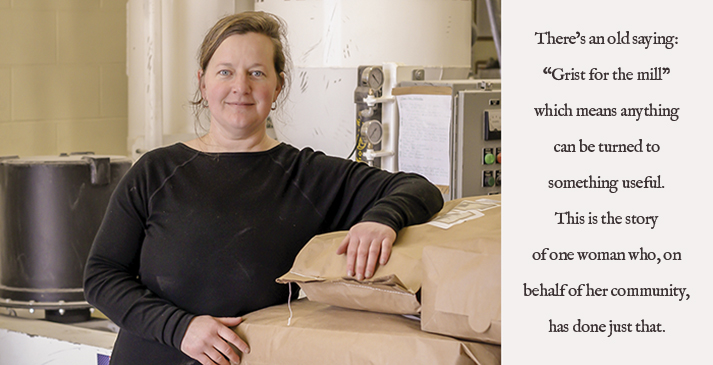
From Jailhouse to Brewhouse:
How Maine Grains became a devoted partner in the craft brewing industry
In the mid-nineteenth century, Skowhegan, Maine was a bustling mill town, but by 1955, the last of its 13 mills had permanently closed, leaving a depressed economy with poor job prospects.
When Brunswick native Amber Lambke and her husband, Dr. Michael Lambke, moved to Skowhegan in 2007, they were eager to get to know their neighbors and get involved in the community. Amber was a natural “connector” and wanted to improve community development at the grassroots level, so she began volunteering at a number of local Skowhegan events, including co-founding the first Maine Kneading Conference that same year, which brought farmers and bakers together around the art and science of growing and milling grains and baking artisan breads.
From earth to hearth, a strong idea formed. Farmers were willing to grow and harvest grains and bakers certainly wanted the product, but what was missing? A mill: a place to process the grain into flour.
With this inspiration to create opportunities for local farmers, Maine Grains built a gristmill inside a re-purposed county jailhouse, restoring the tradition of local flour and oat production to the community and to the region. Since its founding in 2012, the mill has catalyzed an industry cluster around local grains, enabling bakers, maltsters and brewers to incorporate local grains to make superior products.
“As more industry leaders make a commitment to local sourcing, the mill is poised to support even more growth for the region’s organic grain farms,” said Amber Lambke, Maine Grains’s co-founder. With this processing infrastructure now in place, Maine farms have invested more and more acreage to grain, thus in turn, are better able to meet the ongoing and future grain demands.
And the craft brewing industry has been paying attention. For example, Allagash Brewing Company made a commitment to purchase one million pounds of Maine-grown grain, per year, by 2021.
Rob Tod, Founder/Brewer of Allagash Brewing Co. was one of Maine Grains first brewery customers. “Amber has played a big role in the development of Maine’s brewing scene,” said Tod. “Her outspoken support of Maine’s natural grain-yielding capability—and Maine Grains’ role in supplying breweries with quality, locally grown grain—is hard to quantify. Maine’s brewers are lucky to have her.”
The ever-increasing ability of Maine craft brewers to buy all of their hops, adjunct and malted grains from their own region provides a distinctive edge in the national craft brew conversation, where “local” is becoming more and more important to the consumer.
In the last five years, Maine Grains has provided their products to roughly 25 percent of Maine’s brewers and the craft beer industry continues to be a rapidly growing segment of their business.
Maine Grains is fully committed to Maine’s craft beer industry. Taking its cue from presenters at this year’s New England Craft Brew Summit , Maine Grains recently sponsored a Beer-Bread Pairing event, which included industry leader representatives such as Allagash Brewing Co., Baxter Brewing Co., Foundation Brewing Co., the Maine Beer Company, the emerging Bigelow Brewing Co. from Skowhegan and a newcomer, Cushnoc Brewing Co.
“One of our core beers, Olde Federal Grisette, a tart Belgian style, incorporates oats, rye, spelt and wheat from Maine Grains as adjuncts,” said Chris Geerlings, Head Brewer at Cushnoc Brewing Co., a brewery opening soon in Augusta. “We love that our interpretation of this historical style also supports Maine farms and mills,” he added.
With concentrated effort and forward thinking, Amber has helped rally a movement to revitalize an erstwhile milling industry, and in turn, has created jobs, strengthened the community and established a symbiotic economy between farmers and brewers. Now, that’s grist for the mill.
~ ~ ~





Maine Brew & Bev
9 Susan’s Way, Windham, Maine 04062
Tel: 207-671-7230
Email: info@mainebrewandbev.com